Categories
World News

ASML’s Q1 Earnings Call Highlights

ASML’s Q1 Earnings Call Highlights

Key points:

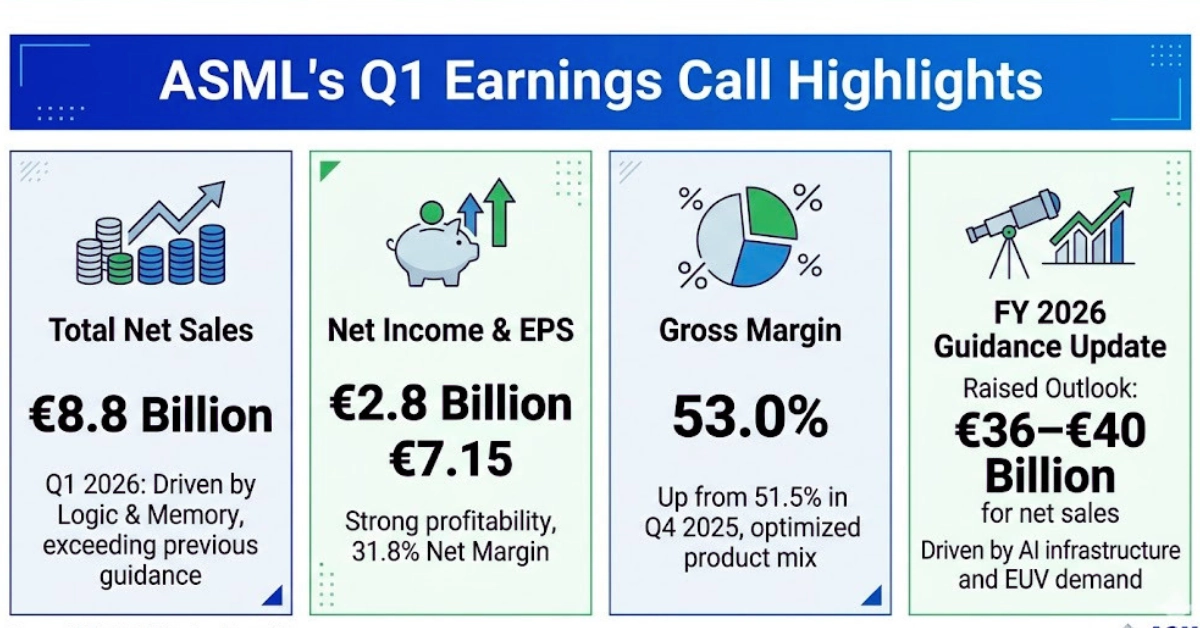
  • ASML reported Q1 net sales of EUR 8.8 billion with a 53% gross margin and installed-base revenue of EUR 2.5 billion and forecasts Q2 sales of EUR 8.4-9.0 billion with a gross margin of 51-52%.
  • The business boosted its full-year revenue forecast for 2026 from EUR 36 billion to EUR 40 billion, citing continued AI infrastructure spending, which is causing supply shortages and pushing customers to increase capacity and capex.
  • ASML plans to boost its production of EUV Low NA systems to 60 in 2026 and 80 in 2027 with help from customers, while also increasing the number of wafers processed per hour (about 330 by 2031 with a 1,000 W source; NXE:3800E to 220-230 wph; NXE:3800F to 260 wph) and speeding up the development of High NA technology.
  • MarketBeat Week in Review: March 23 – March 27


ASML (NASDAQ:ASML) reported first-quarter 2026 net sales of EUR 8.8 billion, which fell within the company’s expectations range. ASML’s EVP and CFO, Roger Dassen, stated that installed base revenue contributed EUR 2.5 billion during the quarter, which was “a little bit above the guidance.”


Dassen stated that the Q1 gross margin of 53% was “at the high end” of the company’s forecast. He attributed the success to installed base performance and the mix within that company, saying that some installed base components “commanded quite some strong gross margins. “Dassen said that net profits for the period totaled EUR 2.8 billion.


Q2 2026 guidance: 3 unexpected S&P 500 outperformers in 2026.

ASML’s $8 billion deal is more than a purchase; it’s a prophecy.


Dassen expects overall net sales of EUR 8.4 billion to 9.0 billion in the second quarter of 2026. The company forecasts installed base revenue of EUR 2.5 billion.


Dassen expects ASML’s gross margin to be between 51% and 52% in the second quarter.


Market demand is supported by AI infrastructure spending. ← Microsoft’s Copilot issue is not what you think.

3 European Stocks to Ride Out Market Volatility

Speaking on the call about the market environment, Christophe stated that semiconductor sector growth continues to “solidify,” fueled by investment in AI infrastructure. He stated that the demand for improved memory and advanced logic is projected to surpass supply “for the foreseeable future,” resulting in a limitation that affects end markets ranging from “AI to mobile and PC.”

ASML’s Q1 Earnings Call Highlights

He also stated that clients are being pressed to boost capacity. In memory, he stated that clients have indicated that they are “sold out for 2026” and that supply limitations are projected to extend beyond that date. In advanced logic, he stated that clients are increasing capacity across many nodes while ramping 2 nm to target AI-related products.

ASML Holdings

ASML High-NA EUV is transitioning from development to early adoption. The business has shipped its first high-NA systems, and Intel has approved their EXE:5200 tool for large-scale manufacture. Other customers are still in the testing and qualification stage. Management noted that key performance measures, such as imaging and overlay, are performing as expected. This shows that the technology is ready, lowering execution risk as use grows.


How Competitors Perform Against ASML.

ASML competes with wafer fabrication equipment manufacturers such as Applied Materials AMAT and Lam Research LRCX.


Applied Materials recently expanded its collaboration with Micron to develop better memory chips for AI. The goal is to provide next-generation DRAM, high-bandwidth memory, and NAND solutions that improve speed and performance while using less power.


The work will be completed at AMAT’s EPIC Center in Silicon Valley and Micron’s R&D center in Boise, Idaho. Teams from both organizations will collaborate to accelerate development and get ideas into production faster.


Lam Research and IBM have inked a five-year deal to collaborate on semiconductor technology below one nanometer. Under this arrangement, LRCX and IBM will collaborate to develop innovative materials, manufacturing techniques, and High-NA EUV lithography to support future logic devices.

Exit mobile version