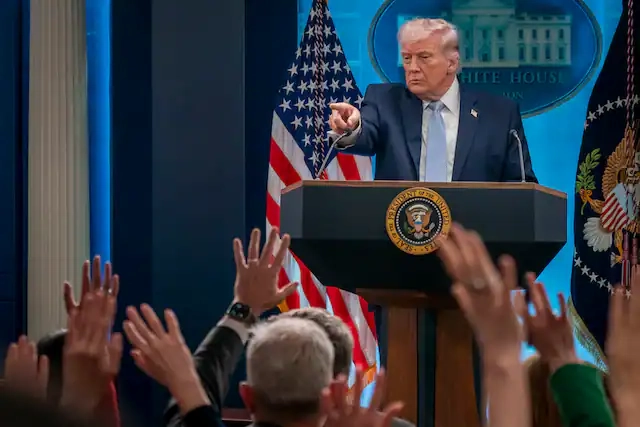
After a month and a half of escalating violence in the Middle East, the United States and Iran agreed to a two-week cease-fire on Tuesday, less than two hours before US President Donald Trump’s deadline, after which he had threatened to destroy a “whole civilization.” That threat, which critics said could be a war crime if carried out, appears to have been averted at the eleventh hour. However, there is still a divide between the two countries, with each portraying the temporary truce as a win for their country.The ceasefire is a beginning point for future negotiations, and it is unclear what final terms would be included in a proposal to end a war that has upended the Middle East and caused a major global oil disruption.
What did the United States and Israel say?
Trump announced the truce in a Truth Social post, stating that it was reached on the condition that Iran agree to reopen the crucial Strait of Hormuz, through which a fifth of the world’s oil flows.The ceasefire was mediated by Pakistan’s prime minister and military leader, he stated. Iran had submitted a 10-point plan, which the US considers “a workable basis on which to negotiate,” Trump noted.He stated that the following two weeks will enable the creation of a definitive agreement.In an interview with the AFP news agency on Tuesday, Trump praised the agreement as a “total and complete victory.” However, he refused to specify whether he would carry out his previous threats to destroy Iran’s civilian infrastructure if Tehran broke the accord, adding simply, “You’re going to have to see.”Shortly after midnight, he took to Truth Social again, saying the United States would assist in easing congestion in the Strait of Hormuz, and also suggesting that significant profits are on the horizon.
What did Iran say?
Abbas Araghchi, Iran’s foreign minister, has stated that if attacks against Iran end, so would Iranian operations.During the ceasefire, the country’s military will ensure safe transit across the Strait of Hormuz.Iran’s semi-official Tasnim News Agency stated that Iran and Oman want to levy passage fees for vessels transiting through the strait during the ceasefire, with the proceeds going toward rehabilitation.Iran’s Supreme National Security Council, the country’s highest security council, issued a more furious statement, claiming it had forced the US to adopt its 10-point plan. It called the truce an “enduring defeat” for Washington.
What are the provisions of the ceasefire agreement?
According to Araghchi, while Washington accepted the “general framework” of Iran’s 10-point plan as a “basis for negotiations,” Iran was also evaluating the US’s 15-point proposal.The entire terms of the US plan have not been released, but it is reported to involve Iran pledging to have no nuclear weapons, handing up its highly enriched uranium, limiting Tehran’s defense capabilities, ending regional proxy groups, and reopening the Strait of Hormuz. Other considerations on the table include acknowledging Israel’s right to exist, according to the two regional sources.Iran had earlier rejected the 15-point plan, with one official calling the demands “largely excessive, unrealistic, and unreasonable” on Monday, despite Trump’s declaration in late March that Tehran had agreed to “most of” the criteria.
While the White House has not specified what Iran’s 10-point proposal entails, Iran’s Supreme National Security Council has outlined essential components of the plan.CNN acquired the statement from Iranian officials. It was also covered by several Iranian state media agencies.It included regulating passage through the Strait of Hormuz, ending attacks on Iran and its regional proxy forces, withdrawing US forces from the region, compensating Iran, lifting international sanctions and unfreezing assets, and passing a binding UN resolution to secure any eventual peace deal.In an interview with AFP, Trump stated that Iran’s uranium will be “perfectly taken care of or I wouldn’t have settled.”
About The Author