Elon Musk’s ambition to colonize Mars appears to have taken a back seat to a far closer and more feasible goal: transporting humans to live on the Moon.It is unclear what Musk meant by a “self-growing city” or whether his ambitions are consistent with NASA’s lunar proposal.Musk stated that the business is still committed to developing a Mars metropolis and plans to start in the next five to seven years.Musk stated in May that SpaceX was preparing to land its first uncrewed Starship on Mars by late 2026.
Musk’s revision of his prior space travel estimates came after SpaceX acquired XAI last week, combining two of his most ambitious companies into the world’s most valuable private firm.Musk has made it a point for more than a decade to publicize SpaceX’s singular focus on building a civilization on Mars, claiming that it has been the company’s driving mission since its founding in 2002.In speeches delivered at aerospace conferences and events for SpaceX employees, he has detailed ambitious—if questionably feasible—plans for establishing a permanent human presence on the Red Planet, claiming that such a step is required to ensure a human colony can survive a potential apocalypse.
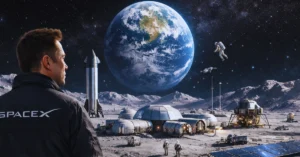
NASA, on the other hand, has prioritized its lunar ambitions, notably since President Donald Trump’s first term, when then-Vice President Mike Pence stated that the United States would return astronauts to the moon by 2024.The audacious plan did not come to fruition, and NASA is now working to return people to the lunar surface by 2028, which was the timeline set by the Obama administration.The return will be the first time humans have set foot on the moon since the Apollo program concluded in 1972.
Musk has previously attacked the efforts, referring to NASA’s moon program, Artemis, as a “distraction” on X early last year.Musk’s apparent shift to a focus on the moon comes as the tech tycoon, whose companies earn large government contracts, has become significantly more active about politics than in previous years.He spent $290 million on the US presidential election, supporting Trump and landing a White House job, only to have a dramatic falling out with the president. He regained his good graces this past fall.
Lunar dispute
While NASA has developed the rocket and spacecraft that will take astronauts off Earth and to the moon, SpaceX has been awarded a roughly $3 billion contract to build the lunar lander, or vehicle that will transport the crew from their spacecraft to the moon’s surface.SpaceX intends to deploy their Starship system for the mission, which is the largest spacecraft and rocket system ever built and, according to Musk, was designed specifically for transporting people to Mars.However, Starship is still in its early phases of development and has frequently detonated during testing.It has never been to orbit or flown operationally, but SpaceX plans to launch a new line of Starship prototypes as early as March.