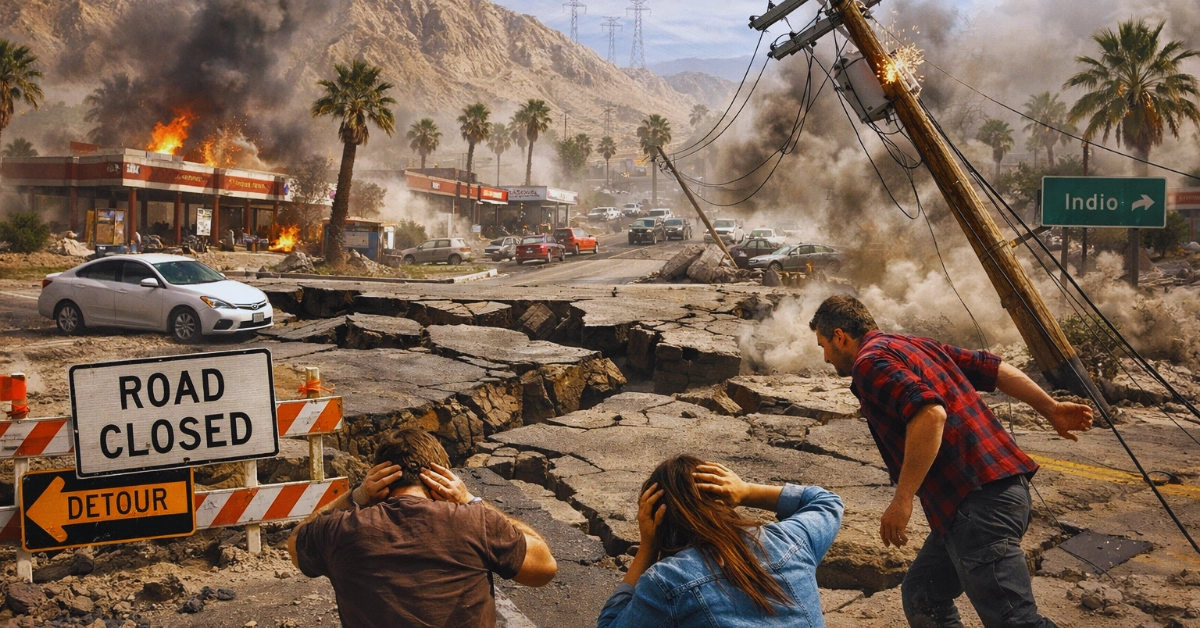
The United States Geological Survey detected a magnitude 4.9 earthquake around 12 miles northeast of Indio.The earthquake struck around 5:56 p.m. on Monday, Jan. 19, causing severe shaking in various portions of the Coachella Valley.Three lesser aftershocks in around the same location occurred immediately following the first quake.The USGS reported a magnitude 3.3 earthquake, followed by magnitudes 3.4 and 2.9 within three minutes of each other.
Palm Springs Police Department spokesman Gustavo Araiza said there were no immediate reports of damage. Initial web reports did not indicate damage to other Coachella Valley communities.
What happens if I am driving during an earthquake?
The California Highway Patrol advises drivers to slow down and pull over as soon as it is safe. Stay in the vehicle with your seat belt tight, engine turned off, and parking brake engaged.Once the shaking has stopped, inspect your car for damage and the occupants for injuries. Only start driving when it’s safe to do so.Once you can resume driving, do so slowly and cautiously, avoiding any portions of the road that appear to be damaged or obstructed, and continuing to avoid bridges and ramps.
If you’re in bed, turn face down and use a pillow to cover your head and neck.If you’re outside, stay away from structures.If you’re inside, remain. Avoid entrances, and don’t run outside.To protect yourself during an earthquake, get on your hands and knees and grasp onto something substantial. Cover your head and neck with your arms and burrow beneath a strong table or desk for protection. If that is not an option, crawl along an internal wall to avoid windows.If you’re under a table or desk, grab it with one hand so you can move along with it.
The California Highway Patrol advises drivers to slow down and pull over as soon as it is safe. Stay in the vehicle with your seat belt tight, engine turned off, and parking brake engaged.Once the shaking has stopped, inspect your car for damage and the occupants for injuries. Only start driving when it’s safe to do so.Once you can resume driving, do so slowly and cautiously, avoiding any portions of the road that appear to be damaged or obstructed, and continue to avoid bridges and ramps.
The Earth has four layers: inner core, outer core, mantle, and crust. According to USA TODAY, the crust and top of the mantle form the “lithosphere,” which acts as a skin over the Earth’s surface.According to the United States Geological Survey, the lithosphere does not exist in a single piece but rather as a jigsaw or succession of parts.These sections of the lithosphere are not stationary and shift gradually. These are known as “tectonic plates.”
According to the California Department of Conservation, the greatest reported earthquakes in California since 1800 are listed below in order of magnitude. 7.9: Jan. 9, 1857, at Fort Tejon, two dead; produced a 220-mile surface scar.

Sports journalist covering NBA, NFL & MLB.
Breaking news, game recaps and player
analysis. Staff writer at USANewsPoint.blog